
Union Minister of Commerce and Textiles Piyush Goyal has stirred up a hornet's nest by taking on India Inc, specifically the Tata group, which is among the companies that lobbied against the Modi government's pro-consumer draft e-commerce policies. While Goyal's comments, made at a Confederation of Indian Industry (CII) event, were streamed live on YouTube, the industry lobbying body later edited the video and subsequently withdrew the entire speech. Goyal had said the Tata group and other Indian companies often lobbied for their interest, while ignoring national interest.

Investors' wealth eroded by over Rs 4.90 lakh crore on Friday amid a sharp fall in equities. The 30-share BSE Sensex tanked 1,020.80 points or 1.73 per cent to settle at 58,098.92. During the day, it tumbled 1,137.77 points or 1.92 per cent to 57,981.95. The market capitalisation of the BSE-listed firms plummeted by Rs 4,90,162.55 crore to Rs 2,76,64,566.79 crore on Friday.

When Open Network for Digital Commerce (ONDC) was conceived last December, the idea was to reduce the dominance of e-commerce giants like Amazon and Flipkart. It was also to bring in a level-playing field for small merchants in India's fragmented but fast-growing $1-trillion retail market. However, those goals have changed now as large e-commerce players such as Flipkart, Amazon and Ecom Express are in various levels of talks with the ONDC team. They want to form partnerships like integrating with the network as well as providing their expertise to build it, according to the industry sources.

India's top listed companies reported their best-ever quarterly net profit of Rs 2.39 trillion in the September quarter of FY22, up 46.4 per cent year-on-year. The earnings were driven by a big surge in the profitability of banks, non-banking financial companies & insurance (BFSI), oil & gas, and metal & mining firms. The combined net profit of these three cyclical sectors were up 87 per cent YoY to a record high of Rs 1.53 trillion, up from Rs 82,000 crore a year ago and Rs 1.08 trillion in Q1FY22.

'Consumers are willing to increase travel spends by 20-30 per cent versus pre-pandemic.'

The market capitalisation of BSE-listed firms reached an all-time high of Rs 288.50 lakh crore on Wednesday amid an ongoing rally in equities, as the benchmark Sensex settled above 63,000-level for the first time ever. The 30-share BSE barometer climbed 417.81 points or 0.67 per cent to settle at 63,099.65, its fresh record closing high. During the day, the benchmark jumped 621.17 points or 0.99 per cent to 63,303.01, its lifetime intra-day peak. Extending its winning momentum to seventh day, the Sensex has rallied 1,954.81 points or 3.19 per cent during this time.

Automobile manufacturers, new and old, as well as ancillary suppliers are set to spend a combined Rs 70,630 crore over the next five years on either entering the electric vehicle segment or stepping up their presence in it. Data culled from announcements made by firms shows India, the world's fifth largest automobile market, is poised to receive one of the biggest capex pushes ever to fuel the transition from internal combustion engines to electric motors and batteries as part of a green drive. The EV push, egged on by the government's emphasis on electric mobility to meet its net zero targets, is expected to yield at least 25 electric vehicles - new ones as well as electrified versions of existing vehicles running on internal combustion engines.

The 30-share Sensex ended up 204 points at 27,215 and the 50-share Nifty ended up 59 points at 8,238.

Indian companies are expecting generous tax incentives from the Union Budget that will help them invest more in building capacities in the coming years. While the productivity-linked incentives (PLIs) are a good start to spur local manufacturing, the government should also take steps to boost consumer demand, which is not showing encouraging signs, say chief executive officers (CEOs) of India Inc. Statistics released by the Reserve Bank of India (RBI) shows that Indian banks had sanctioned loans worth Rs 75,558 crore in 220 new projects - a record low - in the pandemic-hit financial year ending March 2021. This is not showing any signs of a significant pick up in the last nine months of the ongoing financial year.

Old ideas contained in the heads of old economists still dominate. That's not good, asserts T C A Srinivasa Raghavan.

Equity investors became richer by over Rs 5.77 lakh crore on Tuesday, helped by a rally in the broader market where the BSE benchmark jumped nearly 2 per cent. The BSE Sensex zoomed 934.23 points or 1.81 per cent to settle at 52,532.07. Driven by the rally in equities, the market capitalisation of BSE-listed firms jumped by Rs 5,77,006.83 crore to stand at Rs 2,40,63,930.50 crore. "Absence of fresh selling triggers in the domestic and global economy along with falling commodity prices relieved the heavily discounted equity market to showcase recovery.

PharmEasy has acquired Medlife for an undisclosed amount, the e-pharmacy unicorn said on Tuesday. The deal will make PharmEasy the largest player in the domestic online pharmacy sector, with the combined entity set to serve 2 million customers a month.

China on Tuesday announced a major policy change for its crisis-ridden power sector by allowing coal-fired power plants to charge their industrial and commercial customers market-driven prices. The National Development and Reform Commission (NDRC) of China said the electricity generated by coal-fired plants would discover price in market trading "in an orderly manner" from October 15. This is being done to pass on the high costs of coal and is being held up as the boldest reform in the Chinese power sector.

Benchmark indices ended on a flat note on Thursday as fag-end selling wiped out intra-day gains amid weak global trends. The BSE benchmark Sensex slipped 8.03 points or 0.02 per cent to settle at 53,018.94. During the day, it had gained 350.57 points or 0.66 per cent to 53,377.54. Similarly, the broader NSE Nifty fell 18.85 points or 0.12 per cent to close at 15,780.25.

Ride-hailing major Ola on Wednesday said it will launch its electric two-wheeler range in New Zealand. This will help support the New Zealand government's goal of bringing on road 64,000 new electric vehicles by the end of 2021, while also helping the public sector become carbon neutral by 2025, Ola said in a statement. According to the industry sources, the company plans to launch the range in New Zealand over the next 6-9 months.
In all likelihood, the next conventional Chinese attack on India would be preceded by a massive cyber attack designed to cripple Indian networks and interfere with our disaster-relief programmes.

Market benchmarks gave up intra-day gains to close in the red for the sixth session on the trot on Friday, capping a bruising week which saw a massive dash for safety amid rate hikes by global central banks and fears of slowing growth.

Besides high portfolio yield, investors may enjoy capital gains in debt funds in 2023 as bonds rally in anticipation of rate cuts.

Ajit Mishra, vice president, Research, Religare Broking, answers your queries.
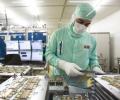
Mumbai-based Indian Semiconductor Manufacturing Company (ISMC) and Singapore-headquartered IGSS Ventures have one strategy in common: They have told the government in their application for semiconductor fabrication plants that they will export the bulk of the chips they make in India in the initial five or 10 years. The third applicant, Vedanta-Foxconn, which is also building a fab plant, has said it will concentrate on the needs of consumer electronics and mobile device markets, and earmark 80 per cent of output for domestic consumption, but has not specified its customers. Finding a viable domestic market could well be the biggest challenge for India's renewed tryst with semiconductors. Fab plants do not sell directly to end users but to intermediary chip design companies - such as Qualcomm or MediaTek.

'The future is about autonomy and tanking.'

Benchmark indices failed to hold on to early gains and closed in the red for the seventh straight session on Thursday, with participants remaining in wait-and-watch mode ahead of the RBI's interest rate decision. Unabated selling by foreign funds added to the pressure, though a modest recovery in the rupee cushioned the fall, traders said. After rallying in early trade, the 30-share BSE Sensex came under selling pressure in the afternoon session and closed 188.32 points or 0.33 per cent lower at 56,409.96.

Gautam Adani's alleged proximity to Narendra Modi may dent the latter's self-styled image of incorruptibility, points out Kanika Datta.

Ajit Mishra, vice president, Research, Religare Broking, answers your queries.

Buying a car, particularly a diesel-powered one, is set to pinch the customers' pockets even more from the next financial year, as the second phase of Bharat Stage VI (BSVI) emission norms kicks in. The rules require cars to be compliant with real driving emission (RDE) norms, which measure pollutants emitted by cars while they are being driven on the road, unlike in a laboratory test. The norms may increase the cost of producing diesel vehicles by nearly Rs 75,000 to Rs 80,000, and petrol-powered ones by Rs 25,000 to Rs 30,000, analysts said.

Nikunj Saraf, Vice President Choice Wealth, answers your queries.

The main losers on the Sensex were Tata Steel, Hero Moto, BHEL, ONGC & Maruti Suzuki.

TCS is confident of achieving a double-digit revenue growth in the current fiscal and will be targeting a similar performance in FY24 as well, a senior executive said on Tuesday. The largest IT services exporter's ability to achieve the number in FY24 will hinge on how the macroeconomic situation, including geopolitical tensions, commodity price pressures, inflation and financial tightening worries, play out, chief operating officer N Ganapathy Subramaniam told PTI. "(For) this year (FY23), probably we are there (double-digit growth).

Indian companies are planning to increase investments in the new year to expand capacity, acquire companies, and go on a hiring spree, a survey of top executives showed. They, however, cited rising costs, weak consumer demand, and increasing interest rates as major concerns for 2023 which may impact their plans.
As the Centre pushes reforms in the power sector, especially for the beleaguered electricity distribution segment, several states, especially those ruled by Opposition parties, are clamouring against it. Maharashtra, West Bengal, Tamil Nadu, and Kerela have voiced their reservations against the proposed amendments to the Electricity Act, 2003. The irony is the states opposing the amendments on the ground of threat of privatisation already have private partnerships in power supply. The proposed Bill was slated to be placed on the floor of Parliament in the Monsoon session. But it still awaits Cabinet approval amid several states complaining that they have been not consulted on the issue.

Omkeshwar Singh, head, Rank MF, a mutual fund investment platform, answers your queries.

Hemlatha Annamalai and P Bala's Ampere Vehicles makes e-vehicles in Coimbatore.

'They are acutely aware of how they can use their power as a means to either continue dominating people or to get ahead.'

Equity indices frittered away a good start to close with modest losses on Monday, pressured by heavy selling in metal stocks after the government imposed export duties on steel-making raw materials to curb soaring prices. The 30-share BSE Sensex opened strong and gained momentum as the session progressed, but came under severe selling pressure in afternoon trade to close 37.78 points or 0.07 per cent lower at 54,288.61. On similar lines, the broader NSE Nifty slipped 51.45 points or 0.32 per cent to end at 16,214.70.

Ajit Mishra, vice president, Research, Religare Broking, answers your queries.

The entry level car, brainchild of Ratan Tata who envisaged giving a safer and affordable alternative to families riding on two-wheelers, received lacklustre response from the Indian consumer. Tata Motors to bid adieu to Nano from April 2020.

Consumer sentiments have been dampened due to several factors like tight liquidity, high insurance, and high costs

The growth was led by family-owned companies and business groups with presence in pharmaceuticals, information technology services, and consumer products.
The third-quarter financials didn't excite market watchers. But equity investors can still make money if they invest in the right stocks.

Sensex may remain under pressure this week due to weak global factors.
